
TL;DR
A barbell bench press builds upper body strength while requiring core stability, a big advantage of free weights.
Download our free and paid program. It’s for busy beginners who want to maximize strength and muscle efficiently. This two-day split is the same one we’ve used with our clients to increase strength by an average of 85% - with about 20 total sets per workout lasting 40 minutes.
Table of Contents
Introduction
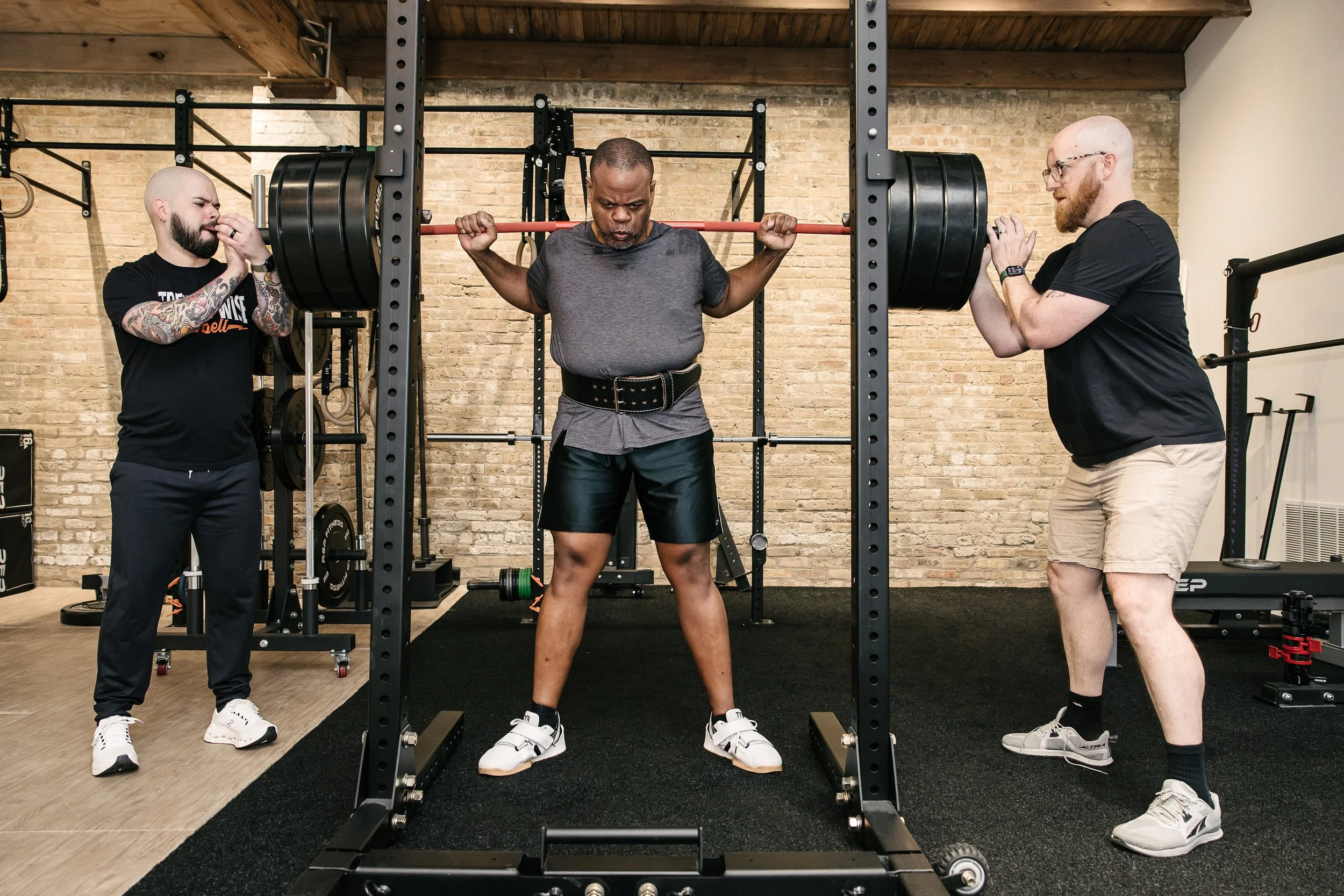
Sherwood hitting a squat PR during our meet day.
You can make weight training as simple or as complex as you’d like.
At Strength Wise Barbell, we value simplicity for our clients. (On our own time, you’ll find us nerding out over the latest strength and conditioning research).
Our coaches know that our lifters have careers and families. They don’t need to master the nuances of mechanical tension; they need a quick, doable program that delivers long-term results.
Simple and efficient has worked wonders for our lifters, who increase average strength gains by 85%. Sherwood, for example, starting lifting with us at age 50 and has improved his squat from 225 pounds to 375 pounds in 10 months.
That’s who we designed our beginner strength program for (click this link for the free and paid versions). We started by documenting the key principles. Then, we translated it through our decades of coaching experience. Finally, we removed any fluff or filler.
The result? A ruthlessly efficient plan made up of two 45-minute workouts.
Here, wanted to expand on the underlying coaching philosophy and logic.
Why Barbell Lifts Are the Foundation of a Beginner Strength Training Routine
At Strength Wise Barbell, we use all the tools of the trade - kettlebells, dumbbells, machines.
But barbell movements form the core of our coaching. They have three unique advantages for building strength:
Work many major muscle groups simultaneously. That’s why barbell lifts are called compound movements. Take the barbell back squat. While it targets the quads and glutes, it still involves the upper body. You need strong shoulders and abs to keep the bar in position. That makes barbell workouts short and translatable to how our body works.
Allow for incremental loading. This applies to all tools, of course. But you can add 2 or 200 pounds to a 45-pound barbell. This often leads to massive strength gains in your first 6 months of lifting.
Spark joy. This is obviously a subjective opinion from a biased source. That said, a heavy barbell deadlift brings a unique sense of accomplishment. Maybe it’s the tactile feel of the steel, or maybe it’s just the realization that you can push yourself hard.
Why We Still Use Machines in Strength Training for Beginners
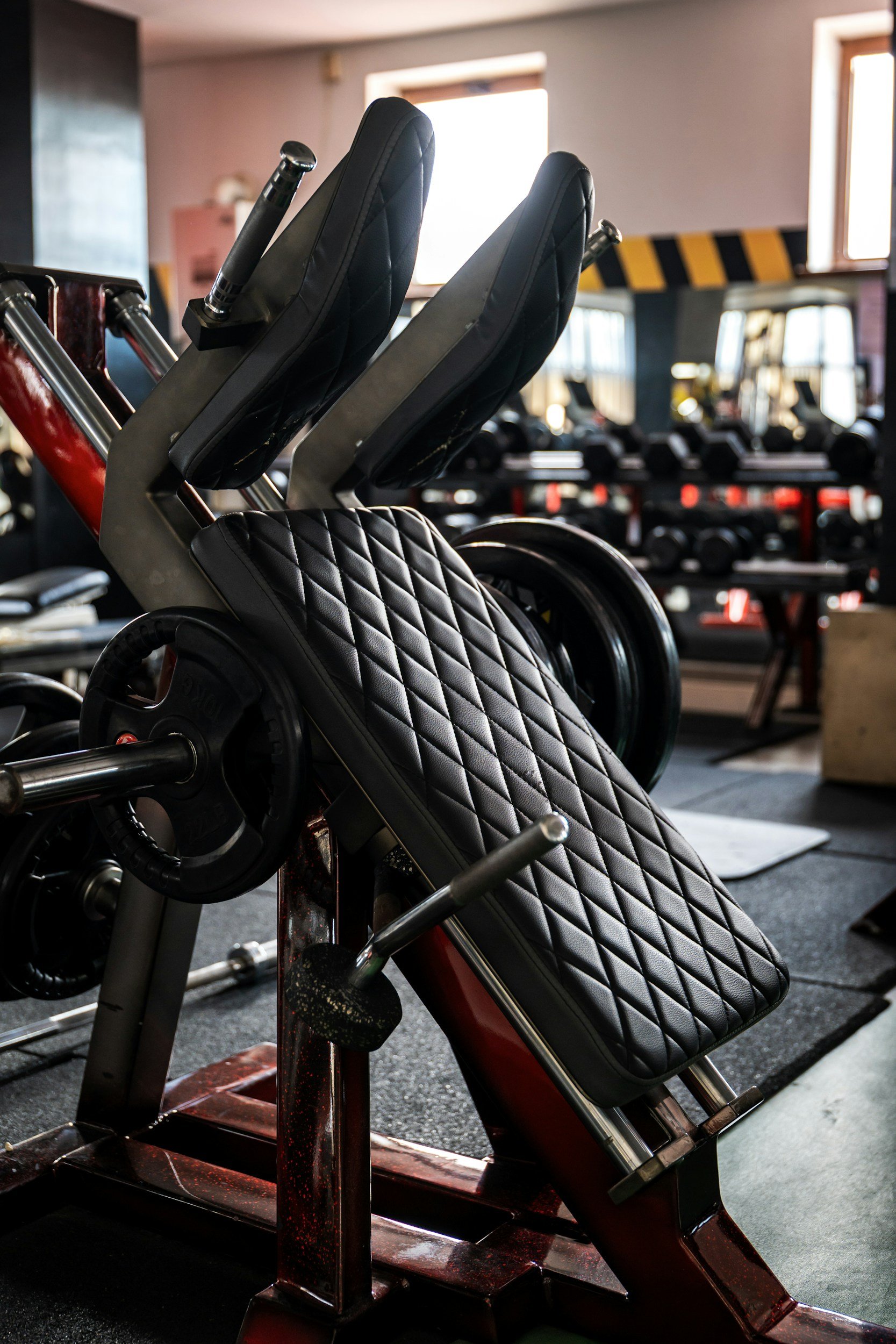
Machines like the hack squat complement the barbell lifts. You can focus on muscle contraction more than technique.
While barbell movements form the core of our training, other tools still play a supporting role.
Machines or dumbbells maximize the benefits of strength training, including:
Building muscle by isolating the body part
We’re using heavy barbells to maximize strength.
Lifting hard immediately rewires your brain, which means you get stronger before you’ve added lean muscle mass.
We follow a different process to maximize body composition. Machines or free weights isolate the muscle we want to grow. A lat pull is one example from the program. You’re locked into place on a fixed machine. You can focus on targeting the muscle contraction.
Build symmetry: Single-arm movements like a bicep curl work each side. That irons out any weaknesses, which is key early in your fitness journey. Stronger links lead to a stronger chain years down the road.
Reps in Reserve: A Smarter Way to Gauge Effort
“How heavy should the weight be?”
That’s a common beginner question.
The easiest answer: learn reps in reserve (RIR).
Before diving into a fuller explanation, we’ll cover some basic science.
We build muscle and strength from training just short of failure. Most of the time, you want to stop your sets 1-2 reps before you completely gas out.
Research shows two main benefits to this approach. First, most of your gains come from pushing to 80-90%. But you also want adequate recovery so you can lift consistently throughout the week.
More quality sessions over time means more progress. Limiting how often you fail also reduces the risk of injury.
So RIR is simply a method for measuring the effort of your sets. A set at 2 RIR means you stopped with two reps “in the tank.” A set at 0 RIR means you couldn’t have done another rep.
This may sound fuzzy, but in reality you can run a quick test.
Say you’re assigned a set of 12 reps with RIR 2. Go to failure on a calibration set. If you fail at rep 13, you went too heavy. If it’s 6 more reps, the weight was too easy. Add weight or subtract weight accordingly for your next set.
Supersets: Getting More Out of Every Session
We’ve paired some exercises together in our program.
That’s known as a superset. Its main benefit is time efficiency.
You perform two movements in a row before resting. A quicker lifting session means you can leave the gym earlier or add zone two cardio. Just make sure each movement works a different muscle group.
Why Aerobic Exercise Matters
In the olden days, coaches worried about the interference effect. The theory: minimize cardio because it could “interfere” with strength gains.
In reality, they mutually reinforce one another.
With strength training, aerobic fitness quickens recovery between sets and between sessions. Improved work capacity has two implications. One, you can get more lifting done inside of a session. Two, over time you can add sessions, which drives further gains over the long run.
Our program includes two sessions per week at zone 2. You can do them after lifting or on a separate day, depending on your schedule.
Zone 2 refers to an elevated heart rate that still allows you to talk. You might remember this as the “talk test” from gym class. Think a moderate jog or hiking on a steep trail. (Your current shape will determine the exact pace of each activity).
Pro tip: if you’re too tired and sore to do zone 2, your lifting is too intense.
Warming Up: Setting your Intention

You don’t need a thirty minute warmup. A few specific warmups based on your workout will do so long as you’re locked in.
Some folks treat their warmups as a mild inconvenience. Others make grocery lists while absent-mindedly swinging their arms around.
The reality: you need to prepare your body for what’s to come. We call our warm-ups “activation drills.” You’re specifically preparing the joints and soft tissues for the upcoming task.
These drills should take no more than 5-10 minutes.
Once done, move on to your barbell lifts. Start with one set of an empty barbell. Then, take 2-3 even jumps from the empty bar to your first working set. Here’s an example if targeting 185 pounds:
Warmup 1: Empty bar (45 pounds)
Warmup 2: 100 pounds
Warmup 3: 150 pounds
Accessory movements generally don’t need this same protocol; a couple of light warm-up reps are enough.
Weekly Progressions
It’s always fun to add weight to the bar. It proves that you’re getting stronger.
As a general rule, target 10-pound increases per week for lower body and 5 for upper body.
However, consider a few nuances.
First, pay attention to your RIR. If you’re supposed to hit RIR 2 and fail, drop down 5-10 pounds. Next session, stay at the lower weight until you’re confidently at RIR 2.
Similarly, focus on technique over weight. You stay at the same weight for a short period while you settle into the right RIR zone. Most people forget you can also get stronger by lifting a lighter weight more effectively. Just make sure you don’t get too comfortable.
Finally, always reinforce your floor even as you chase your ceiling. In practice: during a 4-week training cycle, include some lighter sets. For example, if you’re now regularly benching in the 200-205 range, work in sets between 175-195. Likewise, once you’re consistently at 225, double back to 200-220.
This may sound obvious if you’ve already grasped RIR. Your fifth set of bench press at RIR 2 will be less than your first. Fatigue has set in, so you’ll naturally back off.
We’re calling it out, however, because we’ve seen many lifters run themselves into the ground by constantly chasing PRs. They try to push to stay at their ceiling when they’d make more progress reinforcing their floor.
Utilizing Deloads
In addition to calibrating RIR and progressions, you can deloads to boost recovery. The underlying principle: since fatigue is cumulative, you may need an easier week. That gives your body and mind a chance to restore itself.
During a deload, you’ll reduce your volume and intensity by 50%. So instead of 4 sets at 200, you’ll aim for 2 sets at 100.
You want to maintain enough work for technical practice, but otherwise focus on feeling better. Many clients report that their motivation levels soar. They can’t wait to get back to harder training with a fresh approach.
The Bottom Line
Resistance training can be simple. A few barbell movements and a couple of machines do the trick.
Start using our free program today, and remember a few key ideas:
Focus during your warm-ups.
Work hard, but not so hard you can’t do any more reps.
Increase the weight slightly over time.
Sprinkle in two easier sessions if you’re extra sore.
With that, get strong and be kind.
